
If you have spent any time online in the last few years, you have met the phrase. Someone looks into the camera and says, with total confidence, “I am so lucky, everything always works out for me.” Then they tell you it did. That is lucky girl syndrome, and it is one small corner of a much older idea called manifestation.
This guide is for the curious and the slightly skeptical. We will look at what the trend actually means, what it can realistically do for you, what it cannot, and a gentle way to try it that will not leave you feeling like you failed at being positive.
What manifestation actually means
Strip away the crystals and the neon captions and manifestation is a simple practice: you decide clearly what you want, you talk to yourself as if it is possible, and you pay attention to the small steps that move you toward it. It has roots in early self-help writing from more than a century ago, in visualization techniques used by athletes, and in the plain observation that people who expect good things tend to notice and act on more opportunities.
Lucky girl syndrome is the same idea with a specific script. Instead of “I want a good outcome,” you say “I always get good outcomes,” as if it were already a fact about you.
What it can genuinely do
There is real, unglamorous value here, and it has nothing to do with the universe answering.
- It clarifies what you want. Most of us walk around with vague wishes. Writing “I want to feel rested” or “I want to send the application by Friday” turns a fog into a target.
- It changes what you notice. When you expect a door to open, you look for doors. You reply to the email, you mention the idea to a friend, you apply for the thing. Expectation quietly shapes behavior.
- It softens your inner voice. If your default narration is “this will probably go wrong,” saying the opposite out loud, even awkwardly, interrupts the pattern. That alone can lower the low hum of dread.
- It gives you a ritual. A few minutes each morning where you decide, on purpose, how you want to meet the day. Rituals are steadying.
What it cannot do, and why that matters
This is the part the trend usually skips, and it is the part that keeps the practice kind instead of cruel.
- It cannot override circumstances. Illness, money, discrimination, grief: these are not caused by insufficient positivity, and they are not cured by it. If something hard happened to you, it was not because you failed to manifest well enough.
- It is not a replacement for action, rest, or help. Saying “I am so lucky” is not a substitute for studying, sleeping, or talking to a professional when you need one.
- It should never require you to lie to yourself. If “everything always works out for me” feels absurd on a terrible day, forcing it can make you feel worse. Truthful and hopeful is a better combination than confident and fake.
Held with that honesty, manifestation stops being magic and becomes something more useful: a daily practice of choosing your direction.
A gentle way to try it, with no pressure
You do not need a vision board, an app, or a 30-day challenge. Try this for one week.
Step 1: Choose one small, believable thing
Not “a completely new life.” Something like “a calmer commute,” “finishing the book on my nightstand,” or “one honest conversation with my sister.” Small enough that you can picture it, big enough to matter to you.
Step 2: Write it as if it is already true, but keep it honest
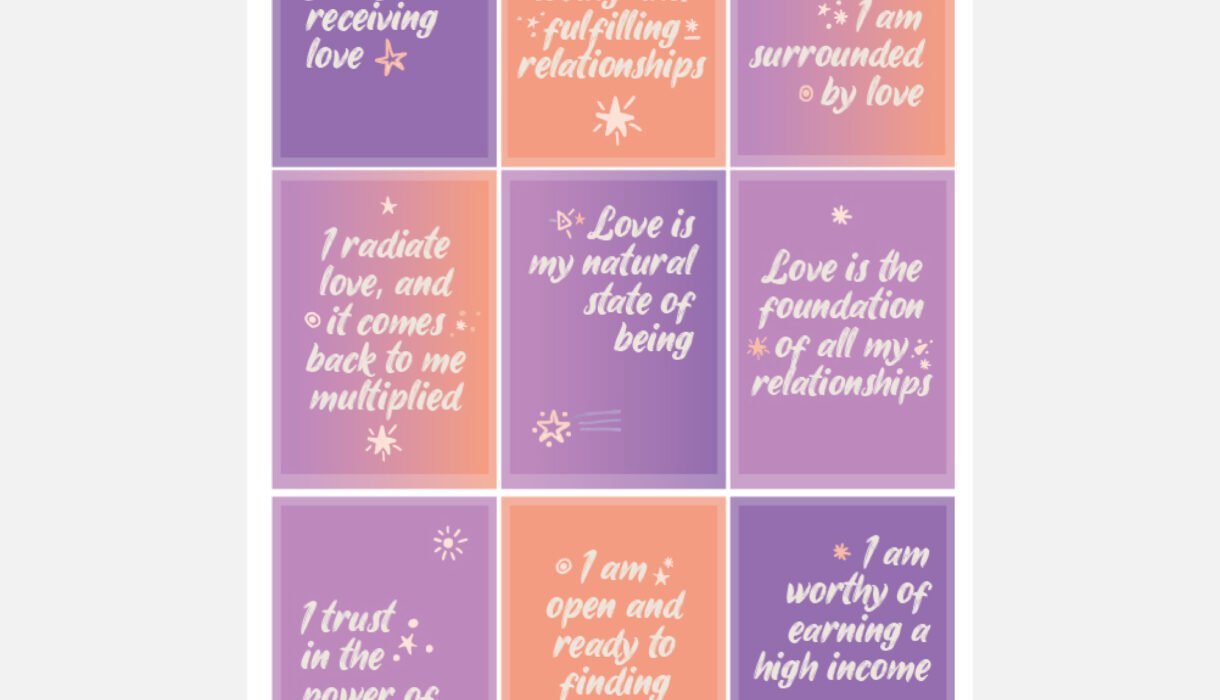
“My mornings are becoming calmer.” “I am the kind of person who finishes what she starts.” Notice the word becoming. It leaves room for reality while still pointing you forward. If you use affirmation cards, pick the one that sits closest to your sentence and keep it where you will see it.
Step 3: Take one tiny step the same day
Manifestation without movement is just wishing. Lay out your clothes the night before. Read five pages. Send the first text. The step proves to your own mind that the sentence is not empty.
Step 4: Notice, do not score
At the end of the day, ask one question: “What went a little better than I expected?” Not “Did it work?” You are training attention, not grading yourself.
Step 5: Let it be imperfect
Some days you will forget. Some days the sentence will feel silly. Both are fine. The practice is not broken because you skipped a day; it is simply waiting for you tomorrow.
A few affirmations that stay on the honest side
- I am allowed to expect good things.
- Small steps count, and I am taking one today.
- I can be hopeful and realistic at the same time.
- Good things are possible for me, and I am open to them.
- I am becoming someone I trust.
If you would like a full deck of sentences written in this spirit, our printable affirmation cards were made to be believable first and pretty second. Print them, cut them out, and keep the ones that feel true today.
And if you try lucky girl syndrome and it makes you feel lucky, wonderful. If it makes you feel pressured, put it down. The practice is supposed to serve you, not the other way around.